



Last week the AI labs looked like landlords, the few companies that own the frontier while everyone else rents. This week we met their landlords.
Two events told the story. SpaceX went public on Friday, the stock ran to a $2.5 trillion valuation, and by Tuesday Elon Musk had used that fresh paper to buy the AI coding company Cursor for $60 billion without spending a dollar of the money he just raised. Money can buy the frontier outright. Meanwhile, on Friday evening, the US government ordered Anthropic to switch off Fable 5 and Mythos 5, the two most powerful models it makes, for every customer on earth. The state can turn the frontier off.
Here's the thing both events have in common. The companies building the most powerful technology of the decade do not actually control it. Two forces sit above them, capital and government, and this week each one reached down and used the frontier like something it owned.

Money, Government, and AI
⚡ The Big Story: SpaceX Went Public, Then Bought a $60 Billion AI Company Four Days Later
On Friday, SpaceX pulled off the largest IPO in history. It sold more than 555 million shares at $135 apiece on the Nasdaq, raised around $75 billion, and then watched the stock jump 19% on day one, touching $176 intraday before easing to a close near $161, a company already worth more than $2 trillion before lunch.
Then it kept climbing. By Tuesday SPCX was trading around $200, up more than half from the offer price, a roughly $2.5 trillion company that had passed Amazon to become one of the most valuable in the country. Worth knowing why, because it isn't all conviction. The day after listing, MSCI fast-tracked SpaceX into its big global indexes, which forces every fund that tracks them to buy. With only about 4% of the company actually trading freely, that mechanical demand hit a tiny supply and the price did what tiny floats do. The average analyst price target sits below where it trades, Morningstar called it overvalued at roughly 95 times sales, and Elizabeth Warren asked the SEC to delay the whole thing over Musk's 82% voting control. For context, SpaceX booked about $18.7 billion in revenue last year, real money that's growing fast, but a long way from a figure that justifies $2.5 trillion on fundamentals alone. None of it mattered. The stock went up.
And here is what Musk did with it. On Tuesday, SpaceX agreed to buy Anysphere, the company behind the AI coding tool Cursor, for $60 billion. The entire deal is in stock, none of the IPO cash, exercising an option SpaceX had quietly locked in back in April. SpaceX wanted it badly enough that if the deal somehow collapses, it has agreed to pay Cursor a breakup fee of $1.5 billion plus $8.5 billion worth of computing power. Because the shares are priced so richly, that $60 billion works out to only about 3.4% of the company. Bill Ackman put the logic plainly, that the deal "costs materially less in dilution because of SpaceX's high valuation." A sky-high price isn't just a scoreboard. It's a currency you can spend.
This is also the latest piece of an empire. Musk folded his AI startup xAI into SpaceX back in February, and Cursor had already been training its newest models on xAI's Colossus supercomputer near Memphis. So the rocket company now owns the satellites, the launch business, a frontier lab in Grok, one of the largest compute clusters on the planet, and a coding tool millions of developers already live in. It has even told investors it intends to put AI compute satellites in orbit by 2028. There's a tidy irony buried in the plumbing too. Anthropic, the company whose models the government just pulled offline, rents 300 megawatts from that same Colossus cluster for about $1.25 billion a month. Musk's rival helps pay for Musk's compute.
For the developers who actually use Cursor, the open question is neutrality. Cursor won its audience partly by being model-agnostic, letting you run it on Anthropic's Claude, OpenAI's GPT, or its own Composer models, whichever was best. Now it belongs to a man who owns a competing model and is not famous for staying neutral. It's also worth noting Cursor was already slipping, with its share of developer spending falling from about 41% last June to roughly 26% last month, so Musk is buying a leader that had started to wobble.
My take: The lesson here isn't really about rockets, or even about AI. It's that in this market a valuation is ammunition. SpaceX minted a $2.5 trillion currency partly on index mechanics and a 4% float, then spent it four days later to buy a frontier AI company outright, no cash required and barely a dent in the share count. Whether the company is truly worth $2.5 trillion is almost beside the point. It's worth enough to go shopping, and right now that's the only number that matters. The richest paper wins, and the people who built Cursor wake up inside Musk's empire whether they like the fit or not.
💻 The Other Big Story: The Government Switched Off Anthropic's Most Powerful Model
Last week I wrote about Anthropic shipping Claude Fable 5, its most powerful public model, just days after warning the whole industry to build a way to slow down. Then the week got much stranger. The day after Fable launched, CEO Dario Amodei published a post calling the underlying Mythos model the "emblematic example" of the national-security threat that frontier AI now poses. Two days after that, the government took him at his word.
On Friday at 5:21pm Eastern, the Commerce Department sent Anthropic an export-control directive ordering it to suspend all access to Fable 5 and Mythos 5 for "any foreign national," whether inside or outside the United States, including Anthropic's own foreign employees. Because there's no way to filter foreign nationals out of a global product in real time, Anthropic did the only thing it could to comply. It shut both models off for everyone, worldwide. Every other Claude model, including Opus 4.8, stayed online. As far as anyone can tell, this is the first time a government has forced a publicly deployed frontier model offline.
The stated trigger was a jailbreak. Anthropic says it received only verbal notice that the government believed it had found a way to bypass Fable's safety system, reviewed a demonstration, and concluded it surfaced a handful of already-known, minor issues. The company is not hiding its frustration. It argues that a narrow, non-universal jailbreak should not be grounds for recalling a model used by hundreds of millions of people, and that if you applied that standard across the board, no lab could ship anything. It called the order a misunderstanding and says it's working to get access back. It also points out that its strongest safeguards run as separate classifier systems sitting outside the model itself, so even if someone talks Fable past a refusal, the hardest limits are supposed to hold anyway.
The backstory matters. The Wall Street Journal reported the letter was instigated by concerns Amazon CEO Andy Jassy raised to the White House, and the Washington Post reported the administration had been weighing Anthropic export controls for weeks, after a dispute over giving a China-linked firm access to Mythos. Back in March, the Defense Department had already labeled Anthropic a supply-chain risk. So this landed on a relationship that was already raw, and it landed right as the company races toward a trillion-dollar IPO.
My take: There are two ways to read this and both should bother you. The first is that the safety messaging worked exactly as designed, just not the way Anthropic hoped. You spend a year telling Washington your model is a national-security-grade weapon, and one day Washington decides to treat it like one. The second read is that this was raw state power with a thin technical pretext, reportedly nudged along by a rival's phone call, aimed at a company the Pentagon had already put on a list and that's about to go public. I don't know which is more true, and honestly it doesn't change the takeaway. The most capable AI in the country was switched off in an evening, for every user on earth, by a letter with no public technical justification. Last week the labs looked like the landlords. This week we found out who holds their lease.
🎯 Quick Hits
- The three biggest AI bosses are sitting with world leaders this week. Sam Altman, Dario Amodei, and Demis Hassabis are all at the G7 summit in Évian, France, running Monday through Wednesday. It's the first G7 to feature the heads of OpenAI, Anthropic, and Google DeepMind at once, with AI infrastructure and regulation on the agenda. After a week when Washington proved it can switch a model off, watching these three pitch the people who hold that power is the subplot to watch. The closing statement lands today. Read →
- A fake bug report can now hijack your AI coding agent. Researchers at Tenet Security published an attack they call agentjacking. Using nothing but a public Sentry key, an attacker can plant a fake error that Claude Code, Cursor, or Codex will read as a real one and then run the attacker's commands with the developer's own privileges. In testing it worked 85% of the time across all three tools, and they found 2,388 organizations exposed. The agents we're handing the keys to still can't tell a real crash from a trap. Read →
- The same week it pulled Anthropic's models, the government went to court to protect Musk's. On Monday the Justice Department moved to throw out an NAACP lawsuit over the dozens of unpermitted gas turbines powering xAI's Colossus data center near Memphis. The DOJ argued that shutting them down "threatens American national, economic, and energy security," citing Grok's role in military operations including the recent Iran strikes. So national security pulled one company's model offline and shielded another's power plant, in the same seven days. The Memphis area already has some of the worst asthma rates in the country, which is the heart of the residents' complaint. Read →
- Microsoft is quietly renting Amazon's cloud to keep GitHub running. AI coding has overwhelmed GitHub's own infrastructure. Pull requests opened by AI agents jumped from about 4 million last September to more than 17 million in March, availability slipped below 89% this month, and Microsoft, which owns GitHub and is migrating it onto Azure, has started borrowing capacity from rival AWS to hold it together. Even the companies that build the world's clouds are now renting from each other. Read →
- OpenAI's books leaked, and they're rough under the hood. Audited 2025 figures, obtained by writer Ed Zitron and verified by the Financial Times, show OpenAI spent about $34 billion last year against roughly $13 billion in revenue. The headline net loss of $38.5 billion is inflated by a one-time accounting charge tied to its for-profit conversion, but the cleaner operating loss still came in near $21 billion. The frontier costs far more to run than anyone earns back yet, which is the whole reason everyone is sprinting to public markets to fund it. Read →
💭 One Thing I'm Thinking About
The two big stories this week looked unrelated and weren't. SpaceX showed that capital can buy the frontier, a $60 billion AI company paid for with paper minted four days earlier. The Fable recall showed that the state can switch it off, an entire model line dark by evening on the strength of one letter. Different powers, same lesson. The labs building the frontier are not the ones who control it.
Look at the plumbing and the point gets sharper. Anthropic, whose model the government just pulled, pays Musk's xAI more than a billion dollars a month for the compute it runs on. Microsoft, which owns GitHub, is renting from Amazon to keep it online. These companies don't just compete. They are each other's landlords and tenants at the same time, and the whole arrangement only holds as long as the money and the politics cooperate.
Which leaves the builders in the middle, the startups and the small teams shipping on top of all this, depending on every layer of it. A model that can be banned. Compute rented from a competitor. A coding tool that can be bought by a rocket company. That's the real state of AI right now, and it has almost nothing to do with whose model scores highest. It's about who has the most money, who has the most power, and who has the fewest dependencies. The lab with the best benchmark score didn't win a single one of this week's fights. This week, almost nobody had all three.
Power in NC, but my vision of it
📍 Local Angle: Two Ways the Week Hit Home for the Triangle
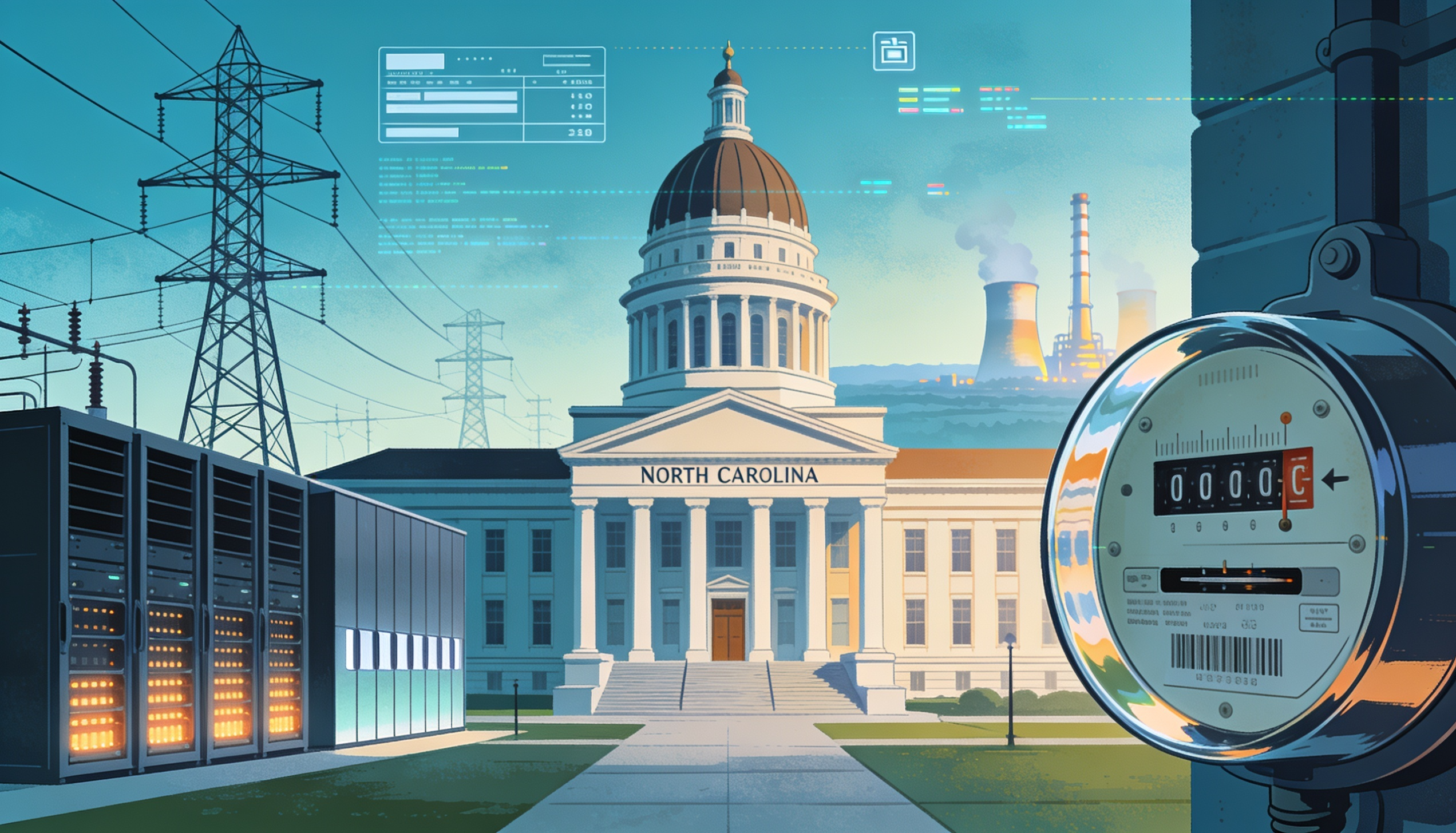
Start with the power grid. The Ratepayer Protection Act, the bill I've tracked the last two weeks that would make data centers pay for their own infrastructure instead of pushing costs onto households, passed the NC House and is now waiting on the Senate. The principle behind it looked obvious in Raleigh. This week it ran straight into Washington.
In the Memphis case I mention above, the federal government argued the opposite of what North Carolina is trying to do. Where our legislature says an AI company should cover the cost and cleanup of its own power, the Justice Department argued that an AI company's gas turbines are too important to national security to regulate at all. Those two views are now openly colliding, and the people caught in the middle are ordinary ratepayers in fast-growing data-center states like ours. Duke Energy is asking regulators for an 18% rate increase right now, so the question of who pays for all this power is not theoretical for anyone in the Carolinas. It's a preview of the fight the NC Senate is about to have.
Then there's the lesson for everyone here building on top of these models. The Triangle's edge was never going to come from training a frontier model, it comes from applying them well inside healthcare, banking, and research. This week showed the catch in that strategy. The foundation you build on can be bought out from under you, the way Cursor just was, or switched off by the government overnight, the way Fable just was. The move isn't to panic. It's to design for it, keep your options open across more than one model, and treat any single provider as a dependency that can change without your permission. That's not pessimism. It's just what building on rented ground requires.
📅 What's Coming
- Today — The G7 summit wraps in Évian with a closing statement. Whatever it says about AI rules and infrastructure is the clearest signal yet on how governments plan to handle the labs sitting in the room.
- This month — Google's Gemini 3.5 Pro is finally due for wide release, the flagship it teased at I/O. It lands straight into the coding fight that Cursor, Claude, and GPT-5.5 are already waging.
- Watch closely — Whether Anthropic gets Fable 5 and Mythos 5 turned back on, and whether the government ever publishes a technical reason it pulled them. The precedent matters more than the outage.
- Third quarter — The SpaceX purchase of Cursor is expected to close. The real tell will be whether Cursor stays open to every model or quietly tilts toward Musk's own.
That's the week we met the frontier's landlords. See you next Wednesday.
Daniel
BullCity AI · Durham, NC
P.S. If your team got caught by the Fable shutdown, or you've been a Cursor shop wondering what the Musk deal means for you, hit reply and tell me what you're doing about it. I'm gathering real stories about model lock-in for a future issue.
P.P.S. Forward this to the person who still thinks the company with the best model wins. This week the company with the richest stock and the friendliest government did.